
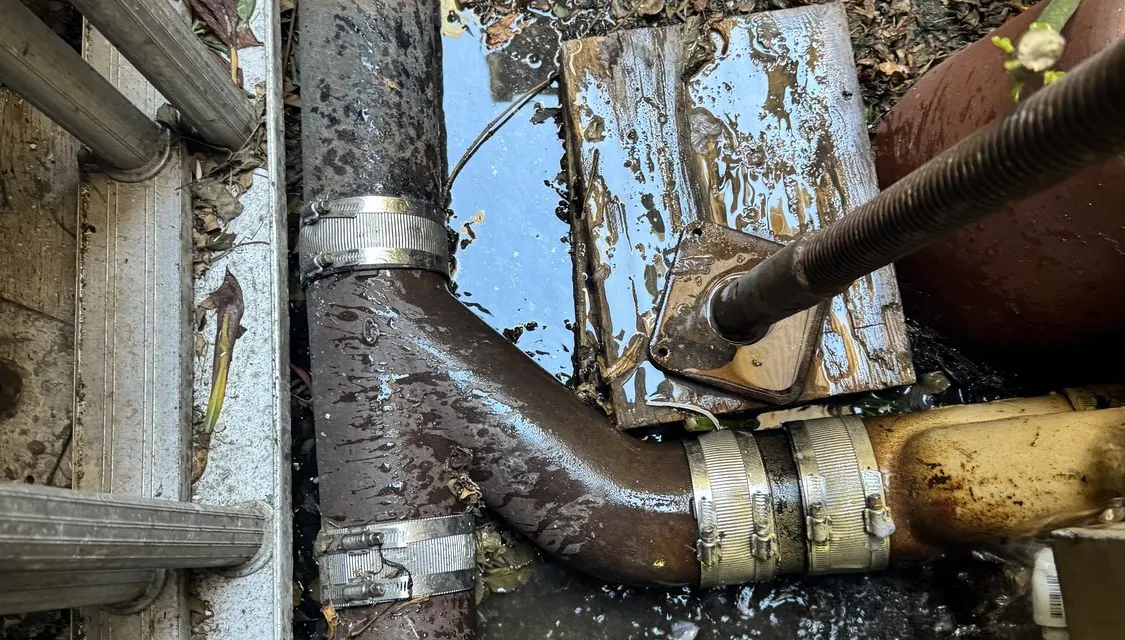
Orangeburg Sewer Pipe in Bay Area Homes: Warning Signs and Repair Options
Many Bay Area homes built between the 1940s and late 1960s have sewer laterals that are far older than the kitchens and bathrooms above them. In some neighborhoods, that buried pipe may be Orangeburg - a tar-impregnated fiber material once used as a lightweight alternative to clay or cast iron. In others, the lateral may be aging cast iron, clay, or a mixture of materials from decades of repairs.
The problem is not simply age. Orangeburg can deform, blister, delaminate, and collapse as it deteriorates. Cast iron can corrode and scale internally until the pipe’s usable diameter shrinks. Clay joints can separate and admit roots. A sewer camera inspection is the safest way to determine what material is underground and whether the line needs cleaning, repair, or replacement.
Why Orangeburg is a Bay Area concern
Orangeburg pipe was installed in many postwar neighborhoods because it was inexpensive and easy to work with. It is made from layers of wood fiber or paper bound with pitch or tar. Unlike modern PVC or ABS, it was never intended to last indefinitely.
South San Francisco’s 2022 sewer lateral ordinance report specifically noted that contractors used Orangeburg for most sewer laterals built in the 1950s and 1960s. The same report described Orangeburg as heavy stock paper reinforced with tar and noted a design life of roughly 50 years. Many of those homes are now more than 70 years old.
That does not mean every midcentury home has Orangeburg. It means age alone is enough to justify a closer look, especially if the lateral has never been replaced.
Homes most likely to have older sewer pipe materials
The highest-risk properties are generally those built or connected to the sewer before modern plastic pipe became common. These include many homes in:
- San Francisco’s pre-1970 neighborhoods
- South San Francisco’s postwar housing tracts
- Daly City’s midcentury developments
- Pacifica neighborhoods with mature trees and older laterals
- San Bruno and Millbrae homes built before the 1970s
- San Mateo, Belmont, and San Carlos properties with original sewer connections
- Redwood City homes with mature landscaping and older clay or cast-iron lines
The only reliable confirmation is visual documentation. A permit record may show the original material, but repairs over the years can create a patchwork of cast iron, clay, Orangeburg, ABS, PVC, and transition fittings.
What Orangeburg looks like on camera
A plumber does not need to excavate the yard to identify likely Orangeburg. On camera, deteriorated fiber pipe may show:
- Oval or flattened sections rather than a round pipe
- Blistering or bubbling along the interior wall
- Delamination, where layers peel inward
- Dark, fibrous pipe surfaces
- Deformation around joints
- Sections that hold water because the pipe has lost shape
- Root entry through softened or separated areas
- Collapse or near-collapse that stops the camera
These findings differ from ordinary grease or paper buildup. Cleaning may improve flow temporarily, but it cannot restore a pipe that has lost its structural shape.
How cast-iron sewer pipe fails differently
Cast iron is rigid and strong, but it corrodes over time. Inside the pipe, corrosion and scale can create a rough surface that catches toilet paper and solids. As the internal diameter narrows, clogs become more frequent.
A camera may show:
- Heavy rust scale
- Channeling along the bottom of the pipe
- Cracks at hubs or joints
- Corrosion holes
- Graphitic deterioration
- Roots entering through failed joints
- Standing water caused by bellies or offsets
Descaling or hydro jetting may improve a cast-iron line if the pipe still has structural integrity. If the wall is thin, cracked, or collapsing, aggressive cleaning can make the condition worse. That is why camera documentation should come before an aggressive cleaning plan.
Warning signs homeowners notice first
Aging sewer laterals rarely fail all at once. They usually give warning signs for months or years. Pay attention to:
- Multiple drains backing up at the same time
- A toilet that gurgles when a shower runs
- Sewage odors near floor drains or outside cleanouts
- Recurring clogs that return soon after snaking
- Water emerging from a cleanout during laundry or showers
- Soggy areas or unusually green patches along the sewer path
- Mature trees near the lateral route
- A home built before 1970 with no record of sewer replacement
One slow bathroom sink usually points to a local drain problem. Several fixtures backing up together is more consistent with a main sewer or lateral restriction.
Why repeated snaking is not a diagnosis
A drain snake can punch through a soft blockage and restore flow. That can be useful in an emergency, but it does not explain why the blockage formed. If roots enter through a separated joint, they will grow back. If a pipe has a belly, solids will settle again. If Orangeburg is collapsing, a snake may pass through one week and stop the next.
Repeated emergency cleaning without video documentation can cost more over time than a proper inspection. It also risks pushing a fragile pipe into failure.
A better sequence is:
- Restore flow if sewage is backing up.
- Run a camera once the line can be viewed.
- Record the pipe material, defects, and approximate locations.
- Decide whether cleaning, spot repair, lining, bursting, or replacement is appropriate.
- Keep the video and report for future maintenance or a property sale.
For San Francisco homes, sewer camera inspections in San Francisco can document the line before recurring clogs become a larger backup.
When hydro jetting helps and when it doesn’t
Hydro jetting uses high-pressure water to cut roots, remove grease, and scour scale from the pipe wall. It can be highly effective for:
- Root intrusion in structurally sound pipe
- Grease accumulation
- Heavy sludge
- Mineral scale in cast iron
- Preparing a line for a clearer camera inspection
It is not a cure for a collapsed or severely deformed pipe. If the camera shows Orangeburg that has blistered or flattened, aggressive cleaning may remove material but leave the structural problem intact. If cast iron is already thin, the technician must evaluate whether jetting is appropriate and at what pressure.
When hydro jetting is appropriate, professional hydro jetting should be based on the camera findings, not sold as a one-size-fits-all solution.
Repair options for aging sewer laterals
The right repair depends on the pipe material, access, depth, defect location, and how much of the line is compromised.
Spot repair
A spot repair may be appropriate when the line is otherwise in good condition and the defect is limited to one joint or short section. The damaged portion is excavated and replaced, then the connections are restored.
Traditional replacement
Traditional excavation removes and replaces the failed pipe. It is often necessary when the line has collapsed, has severe slope problems, or is not a candidate for trenchless methods. It can also be appropriate when access is straightforward and the homeowner wants the entire run replaced.
Pipe lining
Cured-in-place lining creates a new pipe within the old pipe. It may work when the existing line is stable enough to serve as a host and the defects are suitable for lining. Lining can reduce excavation, but it is not appropriate for every belly, collapse, or severe deformation.
Pipe bursting
Pipe bursting breaks the old pipe outward while pulling a new pipe into place. It can replace the lateral without a continuous trench, but access pits and site conditions still matter. The existing alignment and nearby utilities must be evaluated.
Cleaning and monitoring
If the pipe is structurally sound but has roots, grease, or scale, periodic sewer cleaning may be a reasonable maintenance plan. Monitoring should be based on a documented inspection, not guesswork.
Questions to ask before approving sewer work
Sewer repair is a major investment. Before approving work, ask:
- Can I see the full camera video?
- What pipe material is present?
- Where exactly is each defect located?
- Is the problem structural, maintenance-related, or both?
- Did the camera reach the public main?
- Is a cleanout needed for proper access?
- Is the line a candidate for lining or bursting?
- What permits are required?
- What landscaping, concrete, or hardscape will be affected?
- Is the quote for cleaning, repair, or full replacement?
A trustworthy estimate should connect each recommendation to a visible defect in the video. If the camera could not pass, the estimate should explain the limitation and the next diagnostic step.
Why this matters before a home sale or remodel
Aging laterals can become urgent during a sale, remodel, ADU project, or fixture addition. Several San Mateo County cities have point-of-sale sewer lateral requirements, while others trigger inspection through permitted construction. Even where no certificate is required, buyers increasingly ask for sewer videos on older homes.
Finding Orangeburg after a purchase can turn moving week into a sewer emergency. Finding it before listing or before removing contingencies creates more options. If replacement is needed, sewer line repair or replacement can be planned with the property layout, permit requirements, and timing in mind.
Orangeburg and cast-iron FAQ
How do I know if my Bay Area home has Orangeburg pipe?
Homes built from the 1940s through the late 1960s are more likely to have it, especially if the sewer lateral has never been replaced. A sewer camera inspection is the most practical way to confirm the material and condition.
Is Orangeburg always an emergency?
No. Some Orangeburg lines still carry flow, but deterioration is progressive. If the camera shows deformation, blistering, roots, or collapse risk, it is better to plan repair before a complete blockage or sewage backup occurs.
Can Orangeburg be hydro jetted?
Sometimes it can be cleaned cautiously, but severe deformation or delamination may make aggressive cleaning inappropriate. The camera footage should determine the method and pressure.
Can roots be removed permanently?
Cutting roots restores flow, but roots return if the entry point remains. Long-term correction usually requires repairing or replacing the defective section that allowed the roots in.
Should I replace a sewer line that has not backed up yet?
Not automatically. If the camera shows a sound pipe, cleaning and monitoring may be reasonable. If the line is collapsing, severely deformed, or repeatedly obstructed, planned replacement is usually safer than waiting for an emergency.
Get video evidence before choosing a repair
Older sewer laterals deserve diagnosis before demolition. A camera inspection can show whether the line is Orangeburg, cast iron, clay, plastic, or a combination - and whether cleaning is enough or replacement is the smarter investment.
ASAP Plumbing Pros inspects and services sewer laterals across San Francisco and San Mateo County. Schedule a sewer evaluation if your home was built before 1970, drains back up repeatedly, or has never had the sewer line documented on camera.

Need plumbing service?
Request service online or call our team for installation, repair, and maintenance.
Ready when you are
Plumbing emergency? We're on the way.
Call (415) 728-6391 or request service online — 24/7, every day of the year.